How Race Results Became Racecard Form
Learn how race results became racecard form, and distinguish recorded outcomes from the context and interpretation needed to read a runner’s past.
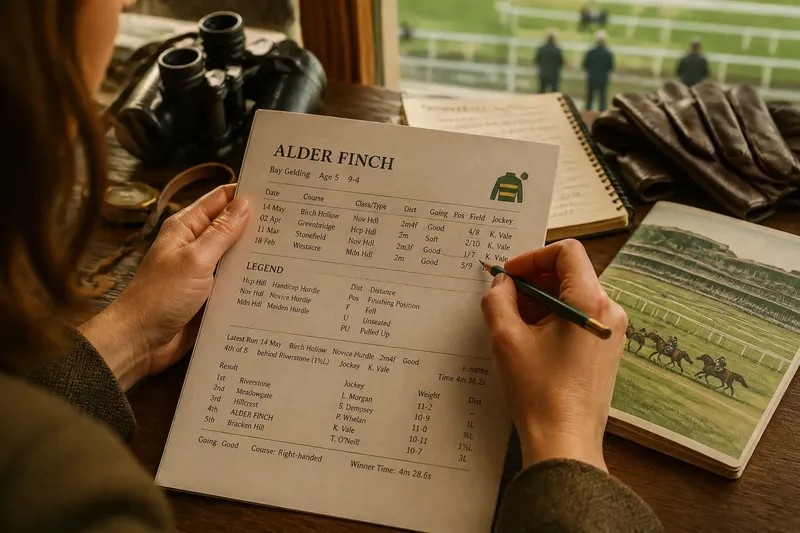
How did a race result become the compact form line on a racecard? The history of racecard form is less a single invention than a gradual joining of records: first an account of a particular contest, then information arranged to identify horses and compare their appearances.
Imagine a fictional reader, Mara, opening a printed card for Alder Finch at a made-up meeting. The card gives her a short record of earlier runs, but each entry depends on information preserved elsewhere: the race, its outcome and enough identifying detail to connect it to the same horse.
Race results supplied the first building blocks
A result is tied to one event. It identifies the contest and records its outcome, giving people at the meeting and later readers a common account of what happened. That is different from a spectator’s memory, which may retain a striking moment but not every placing or the precise conditions.
For a result to be useful beyond its own day, it must be distinguishable from other races. The horse’s name, the meeting and the race details provide ways to identify an appearance. Linking such accounts over time makes a record of a runner’s past possible.
The broad development is clear: information about separate contests could be gathered, associated with particular horses and consulted later. The precise route varied with the records and publishing practices available in a place and period; it should not be reduced to a claim that one universal racecard format appeared at a known moment.
Printed racecards brought selected records to the meeting
A racecard serves an immediate purpose: it presents the upcoming field and relevant information in a form a reader can carry and scan. As past results became available for inclusion, the card could connect today’s runners with earlier appearances rather than treating each race as an isolated event.
That compactness involves selection. A full result can preserve more detail than a small card can comfortably show, so a racecard condenses and arranges information for quick reference. The result remains the account of an event; the card is a presentation that selects details from records.
This distinction also explains why formats differ. Publishers and racing authorities may use different layouts or shorthand, and a symbol that looks familiar may not have the same meaning everywhere. The card’s own legend or the issuing authority’s guidance is the sensible place to check.
Form emerged as a way to read connected appearances
“Form” refers to a horse’s previous performances and, in everyday racing language, to the assessment a reader draws from them. A line of results makes a sequence easier to see, but the sequence alone does not explain why a horse finished where it did.
Finishing position is part of the recorded outcome. Saying that a horse is improving, declining or suited to a certain kind of race is an interpretation. It depends on context such as the other runners, course, conditions and the way the contest unfolded.
As records were condensed into form lines, the reader gained convenience but lost some of the surrounding detail. That tradeoff is still visible on a modern card: the line can point toward an earlier appearance, while a fuller result or race report may be needed to understand it.
Mara follows one result into a later form line
Say Mara’s fictional card lists Alder Finch’s earlier appearances, including a run at a different venue and another under different race conditions. She checks the printed dates and details, then uses the legend to identify an unfamiliar mark rather than guessing at its meaning.
At a fictional Birch Hollow meeting, Alder Finch finishes behind several rivals. Mara checks the official result to confirm the outcome and identify the race. A later card includes that appearance in the horse’s record, so she can see the new placing alongside earlier ones; she still cannot infer a trend from the positions alone, because the races differed.
The worked sequence shows what each format contributes: the result records the event, the later racecard selects and displays the linked appearance, and Mara interprets it with the available context. If the card omits a detail she needs, the appropriate next move is to consult the fuller result or leave that part of the assessment unresolved.
What do racecard form and results tell you?
What is the difference between a race result and form?
A result records the outcome of one contest. Form gathers a horse’s previous performances into a history, which readers may then assess in context.
Why can the same placing mean different things?
Placings come from different fields, courses and circumstances, so they are not automatically comparable. Check the surrounding race details before treating a sequence as a clear pattern.
Are racecard abbreviations universal?
No; shorthand can vary by card and jurisdiction. Use the card’s legend or its issuing authority’s guidance when a mark is unfamiliar.
Does a recent result matter more than an older one?
Recent information may be easier to relate to the present, but relevance depends on how the races compare and what has changed. An older run can still provide useful context if its conditions resemble those under consideration.
Records connect the past without settling the next race
The development from result to racecard form is a development in how racing information is collected, linked and presented. Results preserve outcomes, cards make selected details accessible, and readers use those details to interpret a horse’s history. The distinction matters because a compact record can support a question without supplying a complete explanation.
It is not worth asking a short form line to explain every movement or circumstance of a race. When a detail matters, look for the fuller result or relevant guidance; when that context is unavailable, leave the inference open.
When reading racecard form, start with what the record actually identifies, then ask which conditions make the past appearance comparable to the next contest. That keeps the history useful without mistaking an edited account for a prediction.