Why the Starting Position Changes with the Course
Learn why horse racing starts use stalls or an official line by reading the course layout, so you can follow how each arrangement fits the route.
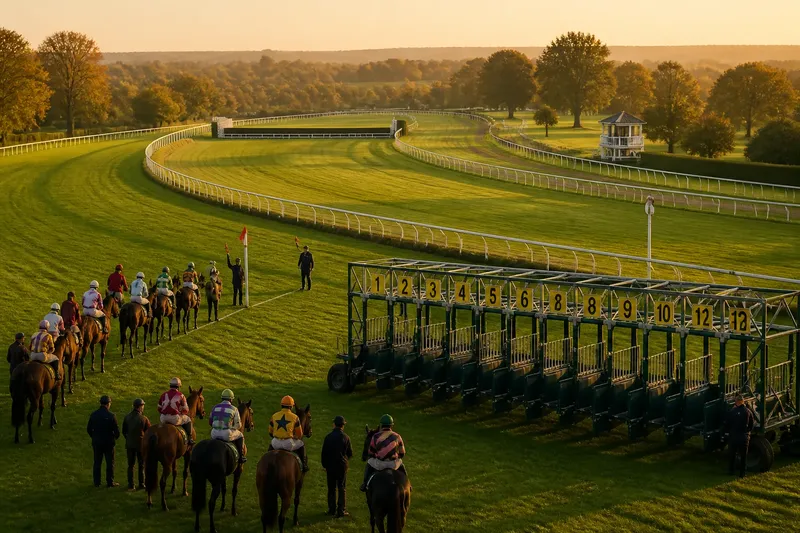
Why does one race begin with horses waiting in numbered stalls while another starts from an official line? In horse racing, the starting method depends on the particular route and the arrangements approved for that race, not on a universal rule that one kind of ground always calls for one kind of start.
The route ahead helps explain the start
On a course map, trace the route from the marked start to the first turn. Note whether the track stays broad, narrows, or joins the main circuit through a chute. That view can explain the demands the course presents, though it cannot by itself establish why officials selected a particular starting method.
A racecourse may have several starting points for different distances. A longer route can begin in a chute that joins the main track, while another race begins on a straight section. The start’s location, the approach to the first turn, and the available ground are useful context when reading the arrangement.
Course maps and race descriptions can help identify these features. For the reason a particular race uses stalls or a line, rely on its official race information or the relevant racecourse guidance; procedures and arrangements can vary between courses and events.
Stalls and line starts are different arrangements
Starting stalls are individual gates placed in a row. Horses enter their assigned stalls, and the gates open to release them. This creates a defined arrangement at departure, but stall positions do not remove differences in the route toward a rail or an approaching turn.
In a line start, horses gather near a designated starting point and an official gives the signal. Depending on the event’s procedure, a flag or another signal may be used. The field is not meant to begin at the riders’ discretion; the start remains under official direction.
Neither description alone tells you how the race will unfold. Horses can break differently under either arrangement, and the track’s shape, nearby runners, and the field’s movement all affect what happens next.
Read course features without treating them as rules
Width, surface, access, and the distance to the first turn are reasonable features to notice when comparing a start with its route. They are context, not a formula for determining which method officials should use. A map may show the geometry, but it may not capture current conditions, equipment arrangements, or the applicable procedure.
It is not worth inferring the full explanation from a broadcast angle alone. A camera view can omit a chute or conceal how the start relates to the wider course. Use the map to understand the route and official information to confirm the stated starting arrangement.
What should you check before interpreting a start?
Does every race on a course use the same start?
Not necessarily. Different distances may begin at different points, and a course can have both a straight route and a chute. Check the start specified for the race you are watching.
Do stalls always indicate a straight track?
No. The presence of stalls tells you that stalls are being used at that starting point; it does not establish that the race route remains straight. Trace the course beyond the start to see where it turns or joins another section.
Does a line start mean riders choose when to go?
No. A line start is directed by an official, who signals the release under the procedure for that event. The arrangement looks different from stalls but is not an informal choice by the riders.
Can the starting method explain an uneven break?
It may be relevant context, but it is not enough on its own to explain what happened. A horse can hesitate or move quickly under either arrangement, and the field’s movement immediately afterward also matters.
Follow the start from map to race
Say you are looking at an invented race whose map shows a short chute joining the main track before a turn. You check the race information and see that the event is designated as a line start. You can then describe the route and the stated method accurately, while leaving the reason for that choice to official guidance rather than assuming the chute’s shape decided it.
- Check the race’s listed starting point. If the information gives a separate chute, trace it into the main route; if it gives a straight-course start, follow that section instead.
- Check where the first turn begins. If the map shows a turn soon after the start, note that the field will encounter a change in direction; if the approach is straight, do not infer that the whole race stays straight.
- Check whether the course map shows a chute or joining route. If it does, follow how the route connects; if not, avoid assuming that the start sits directly on the main circuit without checking race information.
- Check the official description of the starting method. If it names stalls, describe the start as a release from gates; if it names a line start, describe an official-directed release from a line.
- Check whether the course information explains the arrangement. If it gives a reason, use that stated explanation; if it does not, treat the layout as context rather than claiming it proves why officials chose the method.
- Watch how the field moves after release. If runners bunch or spread, describe that as what happened in the opening; if the camera view is unclear, avoid attributing the movement to the starting method alone.
For a quick explanation of why the starting position changes with the course, identify the exact start, follow the route ahead, and confirm the stated method in official information. That sequence makes the opening easier to read without turning visible course features into unsupported claims about official decisions.